
Building Venture - An AI-Driven Platform for Founders Who Don’t Want to Fail
Here’s a cleaner version in your voice, with the Venture positioning stronger and less robotic.
Venture: Helping Founders Build Better and Investors Invest Smarter
Startups do not usually fail because the idea is terrible.
They fail because founders do not understand themselves well enough.
Or their co-founders.
Or their market.
And on the investor side, the problem is different but connected: investors are drowning in noise. Too many pitch decks, too many cold emails, too many “next big thing” startups, and not enough structured insight into the people actually building the company.
That is exactly why I built Venture.
Venture is an AI-native platform designed to help founders build better and investors invest smarter.
The Real Problems I Have Seen
After building startups, working with founders and speaking to investors, I kept seeing the same patterns.
Founders often struggle with:
- finding the right co-founder , not just a friend, but someone genuinely complementary
- building products outside their real skills and experience
- taking fancy titles , like CEO, CTO or CPO, without understanding the responsibility behind them
- building what they want , not what the market actually needs
- ignoring founder-market fit , which almost always comes back to hurt them later
Investors have a different problem.
They see too much noise and not enough signal.
They deal with:
- endless cold emails from random startups
- deal sourcing spread across scouts, events, LinkedIn, intros and pitch competitions
- founders relying on hype, logos or “ex-Google / ex-Uber” badges
- limited visibility beyond the pitch deck
- due diligence processes that change from startup to startup
- lack of structured early-stage data for fast decision-making
Early-stage investing is still too manual, too subjective and too inconsistent.
Data Is King
Early-stage startup evaluation is broken because there is not enough structured data about the people behind the product.
At the earliest stage, the company is mostly the founder.
So investors should not only ask, “Is this a good idea?”
They should ask:
- Is this the right founder for this problem?
- Does the founder understand the market?
- Does the team have the skills to execute?
- Are the co-founders aligned?
- Is there founder-market fit?
- What has changed since the last update?
- Is the startup actually progressing, or just looking busy?
Founders need this clarity too.
Many founders waste months building without really understanding whether they are the right person for the problem, whether their team is balanced, or whether the market actually wants what they are building.
That is why Venture exists.
What Is Venture?
Venture is a startup intelligence platform for founders and investors.
It helps founders:
- understand their skills, limits and natural roles
- assess founder-market fit before wasting months building
- find better co-founder matches based on skills, personality and gaps
- avoid bad early team decisions
- build with clearer feedback loops from day one
It helps investors:
- source better startups
- understand founders beyond the pitch deck
- track startup progress through structured lifecycle updates
- compare opportunities with clearer data
- run more consistent early-stage due diligence
- use Deal Radar to identify stronger opportunities faster
I think of Venture as a startup failure prevention engine.
Not because it guarantees success. Nothing does.
But because it helps founders and investors catch the obvious mistakes earlier.
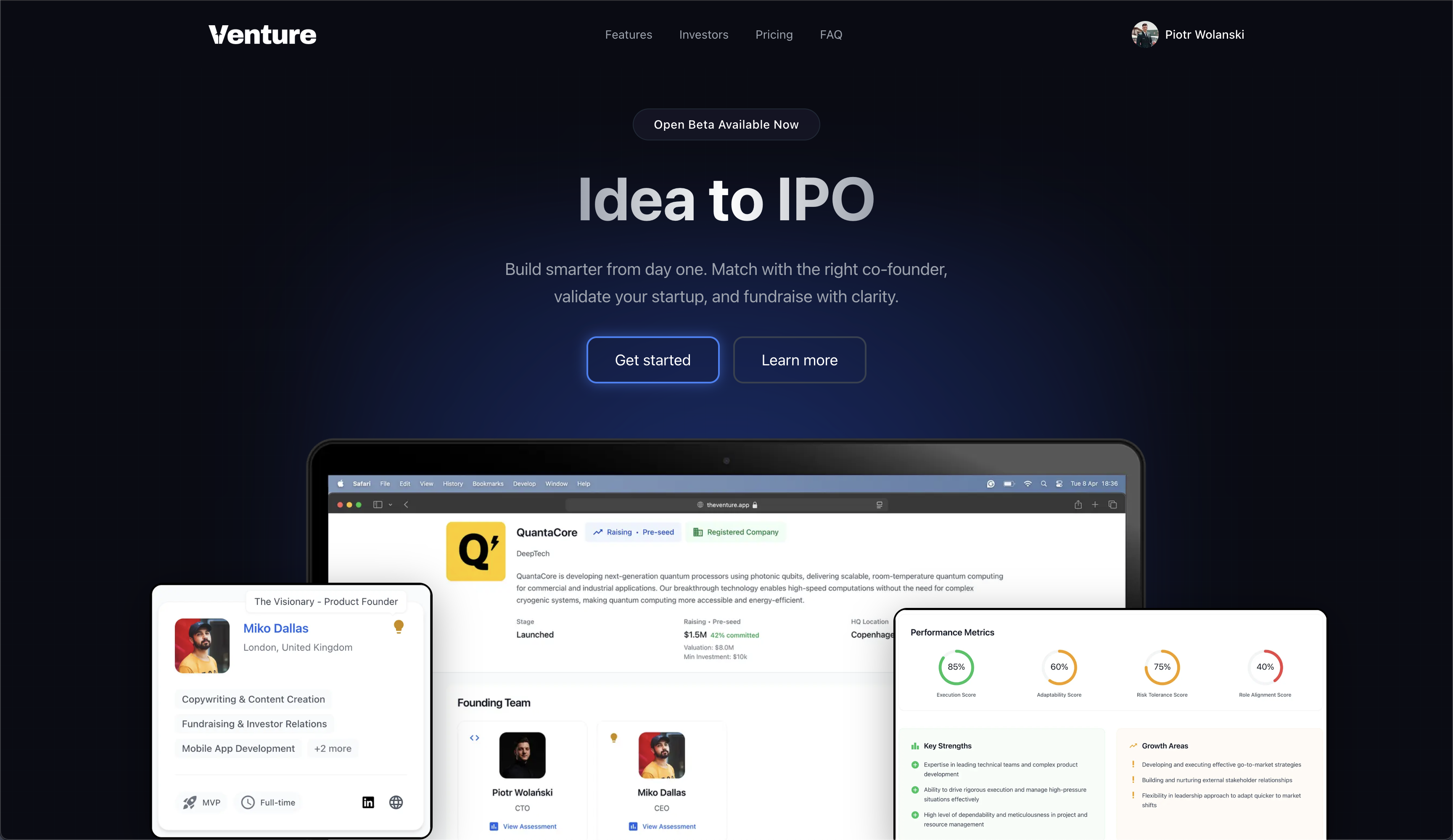
Venture - Beta Version
How I Built It
The build process was simple and fast.
First, I looked at the pain points.
I spoke to founders. I spoke to investors. I looked for repeated patterns. The same problems kept showing up: bad co-founder choices, unclear roles, weak founder-market fit, messy investor updates and too little structured data.
Then I planned a fast MVP.
Simple. Focused. Built for learning.
I planned the roadmap in Jira, set up Bitbucket with CI/CD and used Cursor with AI-assisted coding to accelerate development.
This was not my first MVP.
I had built products in 2-4 weeks before, but Venture was different. The first version was built in less than 24 hours because the scope was clear, the product logic was focused and AI tools helped speed up both coding and UI direction.
I am not a designer, but AI helped shape a clean enough UX/UI without overthinking every detail.
That is especially useful for technical founders.
You do not need to wait for a full design team to test an idea. You can build, ship, learn and improve.
The Real ROI: Time Saved
The biggest gain was speed.
AI did not remove the need for product thinking. It did not magically decide what to build. But once the direction was clear, it helped compress weeks of work into hours.
That is the real advantage: faster execution, faster feedback and less wasted time.
| Task | Typical Time | My Execution Time | Time Saved |
|---|---|---|---|
| MVP Planning | 1-2 days | 2 hours | ~20 hours |
| Setup | 1-2 days | 1 hour | ~12 hours |
| Coding | 2-4 weeks | < 24 hours | ~80-160 hours |
| Design | 1 week | AI-assisted | ~40 hours |
| Content & SEO | 4-6 hours | 1 hour | ~5 hours |
| Total Estimated Time Saved | 3-6 weeks of work | First version built in less than 24 hours | ~150-240 hours |
Why This Matters
Startups are built by people.
But those people need to understand themselves first.
A founder needs to know their strengths, weaknesses, blind spots and unfair advantages. They need to know whether they are the right person for the market, whether they need a co-founder and whether the product they are building is actually connected to a real customer problem.
Investors need the same clarity from the other side.
They do not need another hype deck. They need structured insight into the founder, the market, the team, the traction and the startup’s progress over time.
That is the future I want to see.
Less noise.
More signal.
Better founders.
Smarter investors.
Final Thought
If you are a founder, do not build blind.
Understand yourself. Validate the market. Choose your co-founder carefully. Build with data, not ego.
If you are an investor, stop relying only on warm intros, logos and pitch deck polish.
The best early-stage opportunities are not always the loudest ones.
Venture was built for exactly this gap: helping founders build with more clarity and helping investors make better decisions earlier.
Check out Venture - built for people like you.