
Founder Tips No. 6: B2B vs B2C
I have built both consumer products and software for businesses, and the biggest lesson is simple: they are completely different games.
There is also one thing every young entrepreneur should understand as early as possible:
People do not care about you or your product. The faster you realise that, the better.
They do not care how long you spent building it, how clever the technology is or how much you sacrificed. They care about what it does for them. Does it save time, make money, remove frustration, entertain them, give them status or make their life easier?
Once you accept that, the early-stage job becomes much clearer. You are not trying to prove that your original idea was right. You are trying to poke the market in enough places to find the vortex - the point where attention, urgency, demand and ultimately money are already flowing.
Most things you test will produce very little. Then one audience responds faster, one use case keeps coming back, one sector starts asking for more or one type of customer begins introducing you to others. That is the signal. Once you find it, stop trying to make everything else work and move into the flow.

B2C Is an Attention Game
In my experience, B2C is insanely more difficult than B2B. The technology is not necessarily harder. People are.
A useful consumer product is not enough. You have to capture attention, create curiosity and make people want to return. You need to understand what makes somebody click, share, recommend something or bring another person into the product. There is an element of charm to it.
If you do not enjoy dealing with people, understanding what excites them and constantly competing for their attention, building a consumer business can become increasingly frustrating. You can have a technically excellent product and still discover that nobody particularly cares.
Then comes the cold-start problem. Marketplaces, communities, creator platforms and social products almost always face some version of the same chicken-and-egg scenario. Creators want audiences, audiences want creators, sellers want buyers and buyers want selection. Nobody wants to be the first person in an empty room.
That is why I have always preferred MVPs that provide useful standalone value from the beginning. Build something small, put it in front of real people and test it extensively. Do not spend a year constructing an ecosystem and assume the network effect will somehow appear later. Your first MVP is the fuller version of that.
At the same time, I would not bet everything on one narrow assumption too early. I normally start with three to five logical sectors and use them as probes.
With Superjoi, we looked at Beauty, Fashion, Travel, Music and Education. The objective was never to conquer all five. We were looking for the strongest pull.
Once Music started working materially better than everything else, the decision became simple: double down on it and stop trying to catch every bird at once.
That focus helped us scale the platform to thousands of people representing almost 150 million followers across social media, while deliberately targeting smaller creators rather than celebrities.
That experience reinforced something I still believe strongly:
A niche does not necessarily mean a small opportunity. Very often, the niche is simply where you find the vortex.
In B2C, Find Cluster Points
There is another lesson that matters enormously when you are trying to solve the cold-start problem:
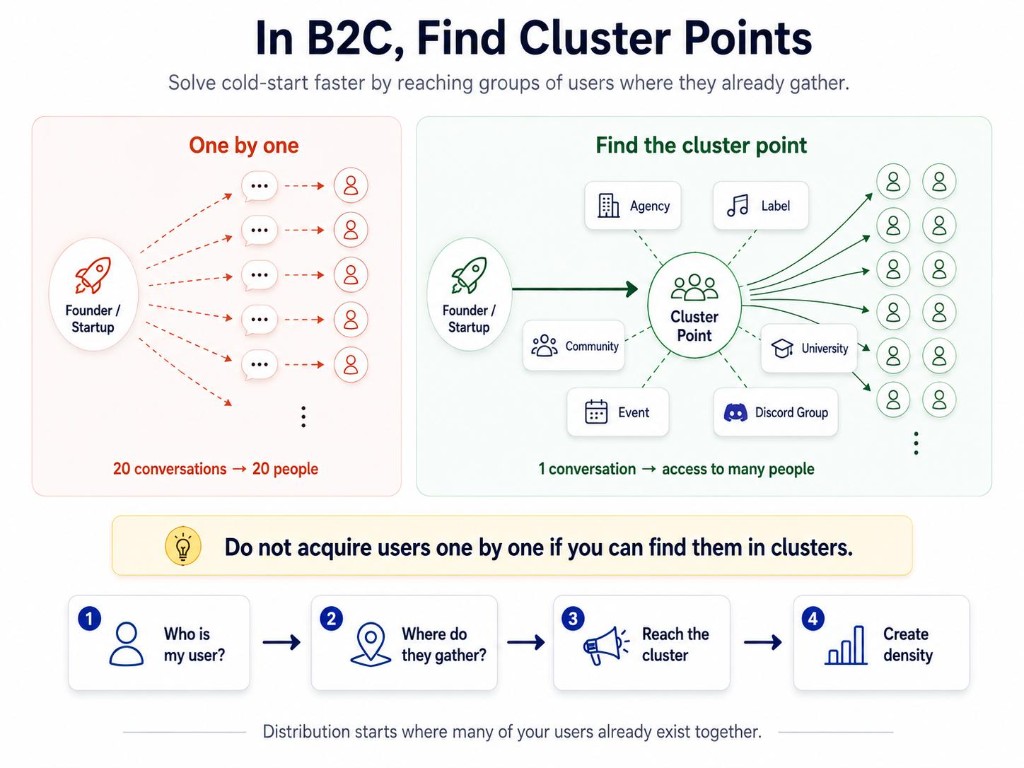
Do not acquire people one by one if you can find them in clusters.
If you are targeting artists, do not spend your time speaking to one artist, then another artist, then another. Find the places where twenty, fifty or five hundred of them already exist together: a management company, label, agency, collective, university, event, community, association, Discord group or some other existing network.
The goal is simple:
Have one conversation that gives you access to twenty people instead of twenty conversations that give you access to twenty people.
Those are cluster points, and they are extremely valuable. Early-stage B2C is not only about whether people like your product. It is also about how efficiently you can create enough density for the product to start feeling alive. One good cluster can replace weeks of individual outreach.
The same rule works almost everywhere. If you want students, find universities or societies. If you want designers, find design communities. If you want fitness enthusiasts, find gyms, coaches or groups where they already congregate.
Do not just ask “Who is my user?” Ask: “Where do many of these users already exist together?” That is often where your distribution starts.
B2B Is About Expensive Pain
B2B works almost in reverse. You do not need thousands of people to love your product. You need one company to have one problem painful enough that solving it matters.
The best B2B problems normally come down to three things: time, money and people. Can you take a process that consumes two days and reduce it to twenty minutes? Can you save the business money or help it make more? Can you remove repetitive manual work currently being performed by expensive employees?
These problems pay because the value can be measured. If five people are spending hours every week maintaining a process and your software removes most of that work, the buyer does not need to fall in love with your brand. The economics do the selling.
This is also why I would never casually enter a B2B market I know nothing about.
I spent years working in highly regulated industries, including energy, so I understand what those businesses actually look like behind the polished websites.
There are old systems, regulatory processes, reconciliations, manual exceptions, legacy workflows and files that have somehow become mission-critical over fifteen years.
That domain knowledge matters because outsiders often see inefficiency without understanding why it exists.
They look at an ugly Excel workbook and ask, “Why hasn't somebody replaced this?”
The better questions are: why does it exist, where does the data come from, who maintains it, who signs it off, what happens when it is wrong, which regulator cares, and which strange exception happens twice a year that everybody inside the company already knows about? That is where the real opportunity starts to appear.
Find the Person Who Actually Owns the Pain
Finding the right B2B problem is only half the job. You also need to find the right person.
I would start with LinkedIn. Research the people inside the companies you believe you should serve, schedule meetings and talk to them about how their work actually gets done. Do not start by aggressively pitching. Exchange ideas, ask about workflows, and understand what takes too long, what breaks, what annoys them and what they wish worked differently.
You may discover very quickly that your original buyer persona was wrong.
Perhaps you assume you should target CTOs because your product is technical. After several conversations, you might realise the CTO is too far removed from the actual problem.
An Engineering Manager may be a much better target because they feel the pain every day, understand the workflow, have influence over the team and may have enough authority or budget to actually change it. That is an important discovery.
Do not become attached to your original buyer persona any more than you become attached to your original product idea.
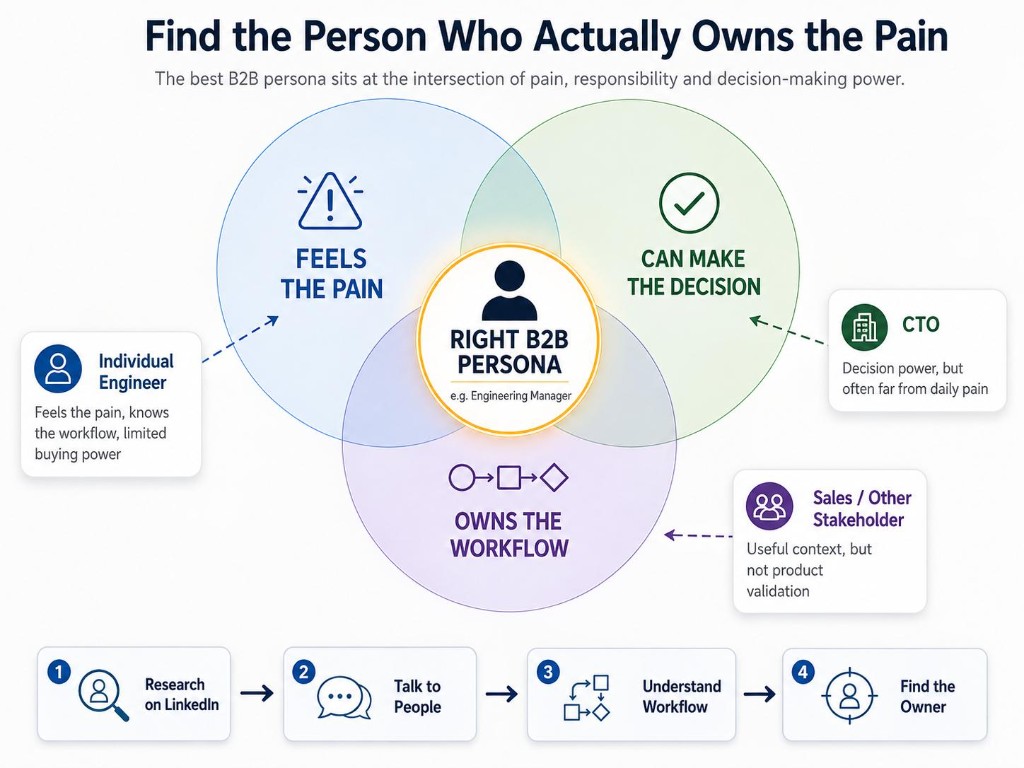
Probe the organisation in the same way you probe the market. Who feels the pain? Who owns the workflow? Who controls the budget? Who can approve a change? Who personally benefits if the problem disappears?
The most valuable B2B persona usually sits somewhere at the intersection of pain, responsibility and decision-making power. That is who you want to spend your time with.
Be careful about validating an idea mainly through people who cannot act on what they are telling you. Someone can think your product is brilliant and still be commercially irrelevant.
Salespeople can give useful market context, but if you are building an engineering workflow product, their enthusiasm does not validate the product. They are not necessarily the person experiencing the problem, controlling the workflow or approving the purchase.
Talk to the person who actually owns it.
Follow the Money Flow
One of my favourite rules of thumb is:
Every important Excel spreadsheet with macros is a potential point solution - and potentially a startup.
Not every spreadsheet is a company, obviously. But when one is passed between several people, contains complicated macros, requires manual data imports, produces a business-critical output or has effectively become somebody's job to maintain, it is worth investigating. Do not laugh at the spreadsheet. Study it.
The spreadsheet normally exists because the business has a genuine requirement that its existing software does not solve properly. Around it, money is already being spent: salaries maintaining the process, hours checking it, operational risk when something breaks, and sometimes consultants being paid simply to keep the workflow alive.
That is the B2B vortex: the point where pain and money already intersect. You are not inventing demand. You are finding an existing flow of money and building something significantly better so that part of that flow moves towards you. That is a much stronger place to build from than inventing a theoretical problem and then trying to convince companies that they should care.
Desire vs Pain
This is probably the simplest way I think about B2C and B2B.
In B2C, I am looking for desire: what captures attention, creates behaviour, makes people return, makes them tell somebody else, and where those people already gather.
In B2B, I am looking for pain: what wastes time, burns money, requires too many people, or forces everyone through a repetitive process they hate - and who owns that problem with enough authority to solve it.
The mechanics are different, but the founder's job is ultimately the same. Do not fall in love with your first assumption. Put probes into the market, watch where the strongest response comes from, find the cluster and the person who actually cares, and understand where the money is already flowing. Then concentrate your resources there.
Probe the market. Find the vortex. Follow the money flow. Double down.